
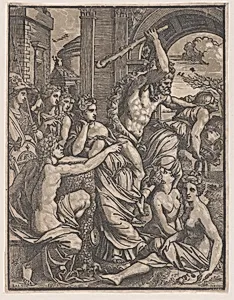
Hercules chasing Avarice from the Temple of the Muses
ca. 1520–27
Medium
Chiaroscuro woodcut from two blocks in green
Dimensions
11 15/16 × 9 1/4 in. (30.3 × 23.5 cm)
Classification
Prints
Department
Drawings and Prints
Museum
Metropolitan Museum of Art, New York, NY
Credit
Rogers Fund, 1920
Accession Number
20.24.76
Rights
Public Domain
Tags
Art Historical Context
In the vibrant world of Renaissance printmaking, *Hercules Chasing Avarice from Temple of the Muses (ca. 1520–27) stands as a masterful chiaroscuro woodcut designed by Baldassare Tommasouzzi, the Sienese architect and painter by High Renaissance ideals, and executed by U da Carpi, a Venetian printmaker. Printed from two blocks in green tones, this 11 15/16 × 9 1/4 in. work captures the muscular hero Hercules driving out the greedy figure ofvarice—often depicted as a monstrous hag—from the sacred Temple of the Muses, guardians of poetry, music, and the arts. The composition pulses with dynamic energy, blending mythology, nudity, and moral allegory to celebrate virtue triumphing over vice. The chiaroscuro technique, using one block for line and another for tone, mimics the dramatic light and shadow of painting, a revolutionary innovation da Carpi helped popularize around 1515–20. This green-toned variant adds an ethereal, almost jewel-like quality, rare for woodcuts and evoking classical frescoes or ancient gems. Peruzzi's design reflects Mannerist elegance, with elongated figures and architectural grandeur inspired by antiquity. Housed in the Metropolitan Museum of Art's Drawings and Prints department (Rogers Fund, 1920), this print underscores the Renaissance fascination with Herculean labors as metaphors for humanism and artistic purity, reminding visitors that true creativity flourishes free from greed's shadow.