
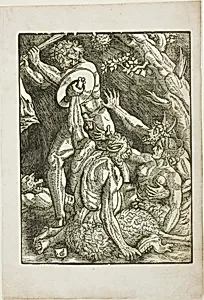
Hercules, Two Satyrs, and a Woman, plate two from The Labors of Hercules
c. 1528
Medium
Woodcut on ivory laid paper
Dimensions
Image/plate: 19.8 × 14.7 cm (7 13/16 × 5 13/16 in.); Sheet: 25.3 × 17.3 cm (10 × 6 13/16 in.)
Classification
woodcut
Department
Prints and Drawings
Museum
Art Institute of Chicago
Accession Number
20487
Rights
Public Domain
About this artwork
A painter at the court of Lorraine, Gabriel Salmon is best known today for his woodcuts of the mythological labors of Hercules. Salmon emphasized the violent action of this rarely depicted scene with the sweeping lines around the figure of the demigod. The woman reaches toward Hercules’ crotch, while one of the satyrs fondles her breast and the other raises his shield against Hercules’ swinging club. The satyrs’ impending doom is foreshadowed by the already-vanquished figure on the ground.
Art Historical Context
In the early 16th century, French printmaker Gabriel Salmon captured the mythic drama of Hercules in *Hercules, Two Satyrs, and a Woman*, plate two from his series *The Labors of Hercules* (c. 1528). This woodcut on ivory laid paper, measuring a compact 19.8 × 14.7 cm for the image, exemplifies the Renaissance fascination with classical antiquity. Hercules, the heroic strongman of Greek mythology, is depicted amid satyrs—mischievous woodland spirits—and a woman, suggesting a playful interlude amid his famous twelve labors, blending strength, sensuality, and the supernatural. Woodcuts like this one were revolutionary for their time, carved in relief on wooden blocks and printed to produce affordable, reproducible images. Salmon's technique allowed intricate details to emerge on laid paper, a high-quality support prized for its texture and durability. Housed in the Art Institute of Chicago's Prints and Drawings department, this work reflects the era's humanist revival, where mythological narratives celebrated human potential and moral virtues, making elite art accessible to a broader audience through the burgeoning print market. Visitors will appreciate how Salmon's precise lines evoke the dynamic energy of Hercules' exploits, a testament to the woodcut's power in disseminating Renaissance ideals.