
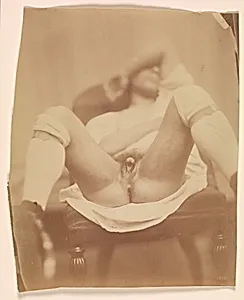
Hermaphrodite
1860
Medium
Albumen silver print from glass negative
Dimensions
Image: 23.9 x 19.2 cm (9 7/16 x 7 9/16 in.)
Classification
Photographs
Department
Photographs
Museum
Metropolitan Museum of Art, New York, NY
Credit
Bequest of Robert Shapazian, 2010
Accession Number
2010.457.1
Rights
Public Domain
Tags
About this artwork
This photograph documents an intersex individual, representing one of nine images created by French photographer Nadar in 1860 that constitute probably the first medical photo-illustrations of a patient with intersex genitalia. The subject appears with a male build and stature and may have been assigned female or self-identified as female. Nadar approached this commission with the same technical mastery and dignified treatment of subjects that characterized his celebrated portrait work, creating...
Art Historical Context
In 1860, renowned French photographer Nadar (aspard-Félix Tournachon, 1820–1910) created *Hermaphrodite*, anen silver print from a negative—one of nine pioneering images documenting an intersex. This photograph captures a subject with a male build and, possibly assigned female or-identifying as such, marking what are likely the earliest medical photo-illustrations intersex genitalia. Possibly commissioned by physician Armand Tseau, the image exemplifies the dawn of photography in clinical practice, blending scientific precision with Nadar's signatureure style, known for its technical mastery and humanistic dignity. Nadar's own medical training in Lyon informed his sensitive approach; despite his fame in journalism, caricature, and celebrity portraits (including of Sarah Bernhardt and Jules Verne), he copyrighted these works in 1861 but restricted them to scientific use, forgoing publication to protect the sitter's privacy. The albumen process, popular in the mid-19th century for its rich tones and fine detail, was ideal for such documentation, allowing unprecedented clarity in medical study. Today, these photographs reside primarily in Paris's Musée d'Orsay, with examples at the Metropolitan Museum of Art. They stand as a milestone in medical photography, reflecting 19th-century curiosity about human biological diversity while honoring the subject's humanity amid evolving scientific ethics.