
Hesbeen
1601 to 1650
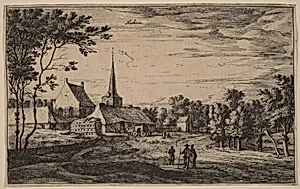
Medium
etching on laid paper
Dimensions
sheet (trimmed to plate mark): 12.8 x 20.4 cm (5 1/16 x 8 1/16 in.)
Classification
Department
CG-E
Museum
National Gallery of Art, Washington, D.C.
Credit
Ailsa Mellon Bruce Fund
Accession Number
1988.32.1
Rights
Public Domain
Art Historical Context
**Hesbeen** is a captivating etching by the Dutch artist Roelanthman, created sometime between 1601 and 1650 during the height of the Dutch Golden Age. Roghman, renowned for his intricate landscape prints, captures the essence of rural Dutch scenery on laid paper—a traditional support prized for its textured surface that enhances the fine lines of etching. Measuring just 12.8 x 20.4 cm, this intimate sheet (trimmed to the mark) invites close viewing, revealing the meticulous detail possible through the etching technique, where acid bites into a metal plate to produce precise, tonal effects. As a topographical print classified in the National Gallery of Art's Prints department (CG-E), *Hesbeen* reflects the era's fascination with accurate depictions of the Netherlands' countryside, blending artistic invention with observational precision. Roghman's style, rooted in the realist tradition of artists like Rembrandt and Esaias van de Velde, showcases his skill in rendering atmospheric depth and natural textures—think misty horizons and rugged terrain. Acquired through the Ailsa Mellon Bruce Fund, this work exemplifies the enduring appeal of 17th-century Dutch printmaking, which democratized art by making detailed landscapes accessible beyond paintings. Visitors will appreciate how *Hesbeen* transports us to a serene Dutch vista, highlighting etching's role in preserving fleeting landscapes for posterity.
About the Artist
Roelant Roghman · 1627–1692
Comment on works: Landscapes