
Het bezoek
1788 - 1792
Medium
color woodcut
Dimensions
347; 258
Rights
Public Domain
About this artwork
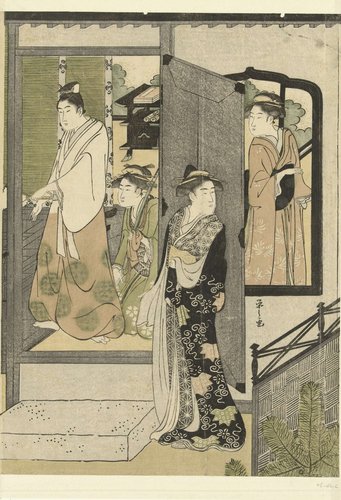
Vrouw staand bij geopende deur, waarachter tweede vrouw kijkend naar edelman en knielende hofdame met zwaard.
Art Historical Context
**Het Bezoek (The Visit)** by Hosoda Eishi (1756–1828) is a captivating color woodcut from around 1788–1792, measuring 347 × 258 mm. Eishi, a master of the ukiyo-e tradition—the "pictures of the floating world"—specialized in *bijin-ga*, elegant portrayals of beautiful women. This print exemplifies his refined style during Japan's Edo period, when woodblock prints democratized art, bringing vibrant scenes of urban life, theater, and courtship to everyday viewers. The composition unfolds like a private glimpse into a tense yet graceful encounter: a standing woman frames the doorway, revealing a second woman peering at a nobleman, while a kneeling court lady holds a sword, suggesting intrigue or ritual service in a high-society setting. Eishi's delicate lines and subtle color layering—achieved through the meticulous *nishiki-e* (brocade print) technique with multiple woodblocks—create an air of poised elegance and emotional depth, hallmarks of his softer, more lyrical approach compared to bolder contemporaries like Utamaro. Culturally, this work reflects late 18th-century Japan's fascination with refined femininity and fleeting social dramas, often inspired by kabuki or teahouse tales. As a window into the *ukiyo* pleasure quarters, it invites us to ponder the hidden tensions behind poised facades, making Eishi's legacy enduringly enchanting.
About the Artist
Hosoda Eishi · 1756–1829
Japanese, 1756–1829