
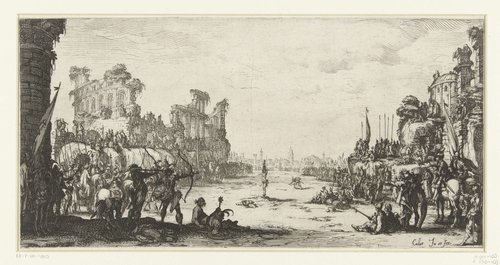
Het martelaarschap van de Heilige Sebastiaan
1631 - 1633
Medium
etching
Dimensions
160; 323
Rights
Public Domain
About this artwork
collector's mark: Lugt 2228
Art Historical Context
Jacques Callot's *Het Martelaarschap van de Heilige Sebastiaan (The Martyrdom Saint Sebastian), etched between 1631 and 1633, captures a dramatic moment from Christian hagiography. The French Baroque master depicts the Roman soldier Sebastian, bound to a tree and pierced by arrows for his faith, surrounded by tormentors in a bustling, panoramic scene. Measuring just 160mm high by 323mm wide, intimate yet expansive etching exemplifies Callot's genius for crowded compositions, blending religious devotion with visceral intensity amid the turmoil of the Thirty Years' War. Callot, a pioneer of etching technique, employed his innovative *écriure* method—using a sharp tool to create ultra-fine lines on the plate—allowing extraordinary detail in tiny figures and textures. This print likely belongs to one of his devotional series, reflecting the Counter-Reformation's push for emotive imagery to inspire piety. Produced in Nancy, France, during a time of plague and conflict, it underscores Baroque art's theatricality, where suffering elevates the soul. Adorned with the collector's mark of Lugt 2228 (Eugène Dutuit), this work highlights Callot's enduring influence on printmaking, bridging fine art and mass devotion. Visitors will appreciate its technical virtuosity, a window into 17th-century Europe's spiritual fervor.
About the Artist
Jacques Callot · 1592–1635
Jacques Callot (1592–1635) was a French printmaker and draftsman from the Duchy of Lorraine, widely regarded as one of the first great artists to practice the graphic arts exclusively. His more than 1,400 etchings chronicled the breadth of 17th-century life, from Medici court festivities to the brutal realities of warfare. Callot revolutionized etching through technical innovations including the é...