
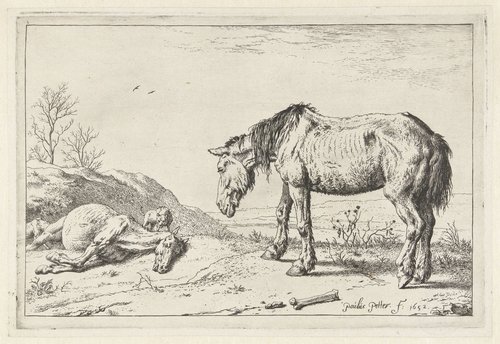
Het stervende paard
1652
Medium
etching
Dimensions
162; 242
Rights
Public Domain
About this artwork
height 162 mm x width 242 mm
Art Historical Context
**Het stervende paardThe Dying Horse)** by Paulus Potter (1625–1654) is a poignant etching from 1652, capturing the Dutch Golden Age's fascination with the natural world and animal life. Potter, a prodigious talent who rose to fame in his twenties, specialized in realistic depictions of livestock and rural scenes, often infused with dramatic tension. This work exemplifies his mastery of animal anatomy and emotion, portraying a majestic horse in its final moments amid a humble Dutch landscape—a theme that resonated in an era when horses symbolized power, labor, and mortality for the prosperous Netherlands. Created as an etching on a modest plate (162 × 242 mm), the medium allowed Potter to achieve intricate, velvety lines through acid-biting metal, producing rich tonal contrasts and textures far superior to earlier woodcuts. Etchings like this were revolutionary for their reproducibility, making fine art accessible beyond oil paintings. Potter, influenced by Rembrandt, produced only a handful of prints, making this signed piece a rarity that highlights his printmaking prowess. For visitors, *Het stervende paard* invites reflection on life's fragility, blending tender observation with stark realism—a hallmark of 17th-century Dutch art that elevated everyday subjects to profound cultural icons.
About the Artist
Paulus Potter · 1625–1654
Paulus Potter (1625–1654) was a Dutch Golden Age painter whose short life — he died at just twenty-eight years of age — belied an artistic achievement of remarkable originality and influence. Born in Enkhuizen in 1625, Potter trained under his father, the painter Pieter Potter, and later in Amsterdam and Delft, where he absorbed the technical standards of the flourishing Dutch painting tradition. ...