
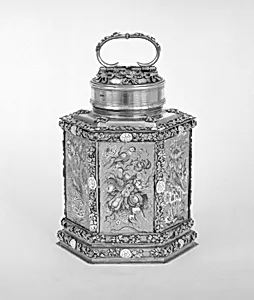
Hexagonal canister (Schraubflasche)
ca. 1650
Medium
Silver gilt, enamel
Dimensions
Height: 9 in. (22.9 cm)
Classification
Metalwork-Silver In Combination
Culture
German, Augsburg
Department
European Sculpture and Decorative Arts
Museum
Metropolitan Museum of Art, New York, NY
Credit
The Lesley and Emma Sheafer Collection, Bequest of Emma A. Sheafer, 1973
Accession Number
1974.356.763a, b
Rights
Public Domain
Tags
Art Historical Context
This exquisite hexagonal canister, known as a *Schraubflasche* (screw flask), crafted by Augsburg goldsmith Jonas Lam around 1650, exemplifies the pinnacle of 17th-century German metalwork. Standing at 9 inches tall, it is fashioned from silver gilt—silver coated with a thin layer of gold for a luxurious sheen—and adorned with vibrant enamel. Augsburg, a renowned center for silversmithing in the Holy Roman Empire, produced such ornate vessels for affluent patrons, blending functionality with opulent display. The canister's surface bursts with intricate enamel motifs of birds, fruit, and flowers, symbols of nature's abundance and the Baroque era's delight in exuberant decoration. The screw-top design allowed secure storage of perfumes, spices, or medicinals, reflecting practical innovation in luxury goods. Enameling techniques, fired onto the metal for durable, jewel-like color, highlight Laminit's mastery, creating a sparkling interplay of gold tones and vivid hues. Housed in The Metropolitan Museum of Art's European Sculpture and Decorative Arts Department from the Lesley and Emma Sheafer Collection, this piece captures the cultural prestige of Augsburg's workshops during a time of artistic flourishing amid religious and political turmoil. It invites visitors to appreciate how everyday objects became canvases for artistic virtuosity.