
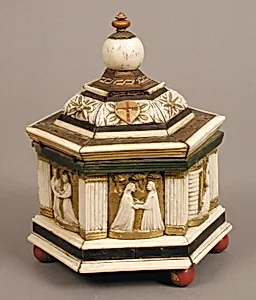
Hexagonal Casket
early 15th century
Medium
Wood, bone, paint, gilding, iron, velvet, and metal-wrapped textile
Dimensions
Overall: 7 5/16 x 5 7/8 x 5 5/16 in. (18.5 x 15 x 13.5 cm)
Classification
Ivories-Bone
Culture
North Italian
Department
Medieval Art
Museum
Metropolitan Museum of Art, New York, NY
Credit
Rogers Fund, 1913
Accession Number
13.149.3
Rights
Public Domain
Tags
Art Historical Context
This exquisite *Hexagonal Casket* from a North Italian workshop, crafted the early 15th, exemplifies the refined artistry of late medieval luxury goods. Measuring just 7 5/16 x 5 7/8 x 5 5/16 inches, its compact hexagonal form—uncommon for caskets—suggests it designed for portability, perhaps to hold jewels, relics, or personal devotional items. The structure combines a wooden core with intricate bone plaques, enhanced by vibrant paint, shimmering gilding, iron fittings for security, and luxurious velvet or metal-wrapped textile interiors, showcasing the era's mastery of mixed media. Artistically, the casket reflects the transition from Gothic to early Renaissance styles in Northern Italy, where workshops blended intricate carving with opulent surface decoration. Bone, a prized ivory substitute, allowed for delicate low-relief scenes likely featuring men and women in narrative vignettes—possibly chivalric tales, biblical stories, or courtly life—bringing the surfaces to vivid life. Gilding and paint heightened their jewel-like quality, making the object a status symbol for elite patrons. Acquired through the Rogers Fund in 1913, this casket highlights North Italian craftsmanship's cultural prestige, bridging secular elegance and spiritual devotion in a time of burgeoning trade and artistic innovation. A true treasure of the Metropolitan Museum's Medieval Art collection, it invites visitors to ponder the intimate worlds of its long-ago owners.