
Hexagonal dish
Unknown Artist
1696
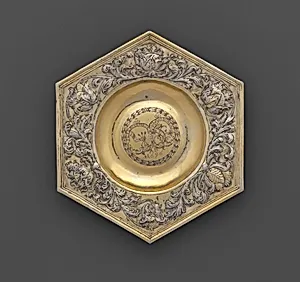
Medium
Silver, partly gilded
Dimensions
Diameter: 9 9/16 in. (24.3 cm)
Classification
Metalwork-Silver
Culture
Hungarian, Transylvania
Department
European Sculpture and Decorative Arts
Museum
Metropolitan Museum of Art, New York, NY
Credit
Gift of The Salgo Trust for Education, New York, in memory of Nicolas M. Salgo, 2010
Accession Number
2010.110.42
Rights
Public Domain
Tags
Art Historical Context
Step into the opulent world of 17th-century Transylvania with this exquisite hexagonal dish, crafted in 6 from silver and partly gilded. Measuring 9 9/16 inches in diameter, this piece from the Hungarian Transylvanian culture exemplifies the metalwork of a region at the crossroads of Eastern and Western European influences. During this era, Transylvania navigated complex political shifts under Habsburg rule following Ottoman dominance, and such silverware often graced noble tables for serving sweets or as ceremonial displays. The dish's hexagonal form—uncommon for tableware—adds a geometric elegance, likely adorned with intricate engravings of flowers and a coat of arms, as suggested by its motifs. Gilding, achieved by applying a thin gold layer to the silver, enhanced its luster and prestige, a technique prized in Baroque-era decorative arts for symbolizing wealth and status. These heraldic elements point to a patron from the aristocracy, personalizing the object with familial pride. Now housed in the Metropolitan Museum of Art's Department of European Sculpture and Decorative Arts, this rare survivor—gifted by The Salgo Trust in 2010—offers a tangible link to Transylvania's silversmithing tradition, blending floral beauty with noble identity in a compact, shimmering treasure.