
Hexagonal dish (part of a set)
second half 17th century
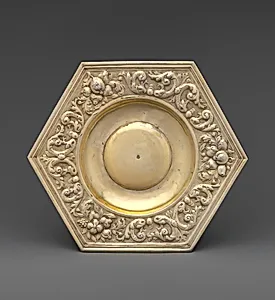
Medium
Gilded silver
Dimensions
Overall: 10 1/2 x 9 5/16 in. (26.6 x 23.6 cm)
Classification
Metalwork-Silver
Culture
Hungarian, Brassó
Department
European Sculpture and Decorative Arts
Museum
Metropolitan Museum of Art, New York, NY
Credit
Gift of The Salgo Trust for Education, New York, in memory of Nicolas M. Salgo, 2010
Accession Number
2010.110.13
Rights
Public Domain
Tags
Art Historical Context
This exquisite hexagonal dish, crafted by the Hungarian silversmith Paulus Roth in the second half of the 17th century, exemplifies the opulent metalwork traditions of Brassó (now Brașov, Romania a vibrant Transylvanian Saxon center. Measuring 10½ x 9 inches (26.6 x 23.6 cm), it forms of a luxurious set likely for serving or ceremonial display. The gilded silver medium—fine silver overlaid with a thin layer of gold—highlights the technical mastery of local guilds, where artisans employed chasing, engraving, and gilding to create shimmering surfaces adorned with floral motifs, evoking the Baroque era's love for elaborate natural forms. In the context of 17th-century Eastern Europe, such pieces reflected the cultural crossroads of Hungarian, Saxon, and Ottoman influences in Transylvania, blending Western European techniques with regional flair. Silverware like this was a status symbol for the elite, showcasing wealth through its durability and luster. Paulus Roth's work stands out for its geometric form and intricate decoration, preserved as a rare survivor of guild craftsmanship. Today, this dish graces the Metropolitan Museum of Art's European Sculpture and Decorative Arts collection, a generous gift from The Salgo Trust for Education in memory of Nicolas M. Salgo (2010). It invites visitors to appreciate how everyday luxury objects encapsulated a region's artistic heritage.