
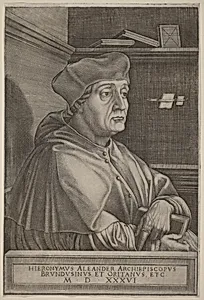
Hieronymus Alexander, Archbishop of Brindisi
Medium
engraving
Classification
Department
CG-E
Museum
National Gallery of Art, Washington, D.C.
Credit
Ailsa Mellon Bruce Fund
Accession Number
1972.33.13
Rights
Public Domain
Art Historical Context
Welcome to the National Gallery of, where Agostino dei Musi's *Hieronymus Alexander, Archbishop Brindisi* (1536) captures the dignified presence of a prominent 16th-century church leader. Agostino, a skilled Italian engraver active in Venice and Rome, was renowned for his precise reproductions of designs by masters like Raphael and Marcantonio Raim. This portrait reflects the Mannerist style emerging in Renaissance Italy, with its elegant lines and refined detail that elevated printmaking to high art. Engraving, the medium here, involved incising intricate lines into a copper plate, inking it, and pressing paper to create multiples—a revolutionary technique for disseminating portraits and religious imagery across Europe. Created amid the Catholic Church's influence during the early Reformation era, the work likely served devotional or commemorative purposes, honoring the archbishop's status in Brindisi, a key Adriatic port. Acquired through the Ailsa Mellon Bruce Fund and housed in the CG-E Prints department, this piece highlights engraving's role in democratizing art. Visitors appreciate its technical virtuosity: fine cross-hatching for shading and texture that brings the subject's robes and features to life, bridging elite portraiture with broader audiences. A testament to Renaissance innovation!