
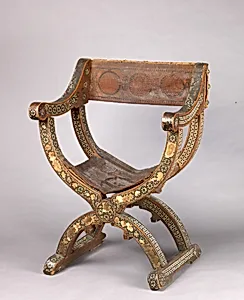
Hip-joint armchair (sillón de cadera or jamuga)
Unknown Artist
ca. 1480s
Medium
Walnut, elm, other woods, ivory, mother-of-pearl, pewter, parchment; leather, tooled.
Dimensions
H. 95.2 cm, W. 71.1 cm, D. 50.8 cm; Seat: 34.5 x 52 cm.
Classification
Woodwork-Furniture
Culture
Spanish (Granada?), Hispano-Moresque
Department
Robert Lehman Collection
Museum
Metropolitan Museum of Art, New York, NY
Credit
Robert Lehman Collection, 1975
Accession Number
1975.1.1978
Rights
Public Domain
Art Historical Context
This exquisite hip-joint armchair, known as a *sillón de cadera* or *jamuga*, hails from late 15th-century Spain, likely Granada, during the final flourish of the Nasrid dynasty. Dating to around the 1480s, it embodies the Hispano-Moresque style—a captivating fusion of Islamic artistry and Iberian craftsmanship that thrived amid cultural exchange before the fall of Granada in 1492. Standing just under a meter tall (H. 95.2 cm), with a compact seat (34.5 x 52 cm), this rare survivor of elite furniture offers a window into the opulent interiors of Moorish palaces or noble homes. Crafted from walnut and elm with accents of other woods, the chair dazzles through intricate inlays of ivory, shimmering mother-of-pearl, and pewter, enhanced by parchment details and tooled leather upholstery. These techniques highlight the Mudéjar mastery of marquetry and damascening, where contrasting materials create geometric patterns and arabesques evoking Islamic splendor. As part of the Metropolitan Museum of Art's Robert Lehman Collection (1975), it stands as a testament to Granada's artistic legacy, bridging medieval Islamic traditions with the dawn of the Renaissance in Spain. (198 words)