
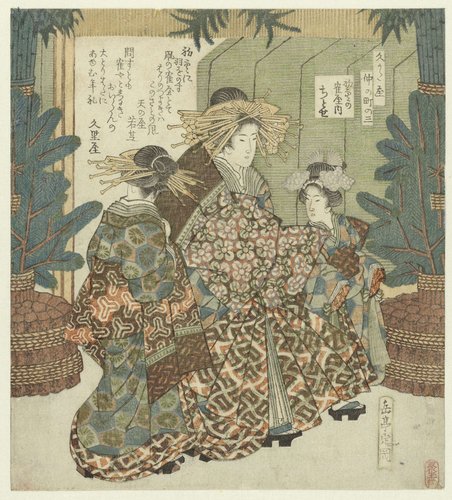
Hisakataya Nakanochô
c. 1827
Medium
nishikie, with metallic pigments and blindprinting
Dimensions
182; 205
Rights
Public Domain
About this artwork
Legaat van J.A. Bierens de Haan, Amsterdam
Art Historical Context
**Hisakataya Nakanoch** is a delicate surimono woodblock print by Yashima Gutei (1786?–1868), a of ukiyo-e from Japan's late Edo period, created around 1827. Gakutei, known for his poetic landscapes and intimate urban scenes, often produced these privately commissioned prints for poetry societies or merchants. The title likely evokes a vibrant shopfront or street scene in Nakanochô, a district of Edo (modern Tokyo), capturing the "floating world" of everyday commerce and elegance amid the era's rigid social structure. This nishikie, or "brocade picture," exemplifies luxurious printing techniques: vibrant colors layered from multiple woodblocks, shimmering metallic pigments like gold or silver mica for a jewel-like glow, and blindprinting (karazuri) that adds subtle embossed textures without ink. At 205 × 182 mm—compact chūban size—it was designed for intimate appreciation, perhaps as a New Year's gift or advertisement, highlighting Edo's innovative print culture. Bequeathed by Dutch collector J.A. Bierens de Haan, this piece bridges Japanese artistry with European appreciation, underscoring ukiyo-e's global legacy. Visitors, imagine holding this tactile gem, feeling the era's refined beauty in your hands.
About the Artist
Yashima Gakutei · 1786–1868
Yashima Gakutei (c. 1786–1868), born in Osaka as the illegitimate son of a Tokugawa shogunate samurai named Hirata, adopted the name from his mother's subsequent marriage into the Yashima clan. Little is documented about his early years beyond these familial ties, but he pursued artistic training under the esteemed ukiyo-e masters Totoya Hokkei and Katsushika Hokusai, absorbing their precision in ...