
Historique du Théâtre de "L'Oeuvre"
1895
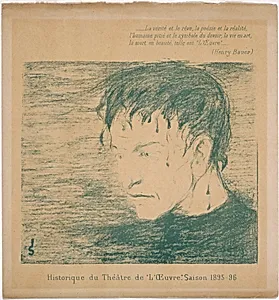
Medium
lithograph in green on light brown wove paper
Dimensions
sheet (program closed): 25.3 x 23.6 cm (9 15/16 x 9 5/16 in.) sheet (program opened): 25.3 x 47.5 cm (9 15/16 x 18 11/16 in.)
Classification
Department
CG-E
Museum
National Gallery of Art, Washington, D.C.
Credit
Gift of The Atlas Foundation
Accession Number
1995.76.113
Rights
Public Domain
Art Historical Context
Joseph Sattler's 1895 lithograph, Historique du Théâtre de "L'Oeuvre", offers a fascinating window into the world of late 19th-century Parisian theater. This print, executed in green on light brown wove paper, was designed as a program that folds from a compact square-like format of 25.3 x 23.6 cm to a wider 25.3 x 47.5 cm when opened, allowing it to present historical information about the Théâtre de l'Œuvre to audiences. Lithography, a versatile printmaking method developed in the 1790s, involves drawing on a stone or plate with a greasy substance and using chemical processes to print multiple copies. By 1895, it was a favored medium for artists creating posters, illustrations, and ephemera, enabling rich tonal effects and the integration of text and image. The monochromatic green ink on warm brown paper likely contributed to an elegant, perhaps mysterious aesthetic befitting a theater program. This artwork, classified as a print in the National Gallery of Art's collection and generously gifted by The Atlas Foundation, highlights the artistic value of functional objects like theater programs. It captures a moment in cultural history when graphic design played a key role in the performing arts, inviting modern viewers to appreciate both its historical context and the skill of its creator.