
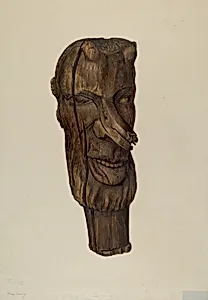
Hitching Post Finial
c. 1940
Medium
watercolor, graphite, and pen and ink on paperboard
Dimensions
overall: 44.7 x 30.3 cm (17 5/8 x 11 15/16 in.)
Classification
Index of American Design
Department
CG-W
Museum
National Gallery of Art, Washington, D.C.
Credit
Index of American Design
Accession Number
1943.8.16555
Rights
Public Domain
Art Historical Context
**Hitching Post Finial** *by Mina Lowry, c. 1940* Mina Lowry's exquisite rendering of a *Hitching Post Finial*, a charming piece of American folk art captured in watercolor, graphite, and pen and ink on paper (44.7 x 30.3 cm). Created around 1940, this detailed depiction showcases the whimsical topper from a hitching post—those sturdy fixtures once essential for tethering horses outside homes, taverns, and public buildings in early America. Finials like this often featured playful animal or eagle motifs, blending utility with regional craftsmanship and pride. Lowry's work is part of the *Index of American Design*, a landmark WPA Federal Art Project (1935–1942) that employed artists to document the nation's rich heritage of decorative arts, folk objects, and crafts. Through precise, colorful illustrations, the Index preserved over 18,000 items threatened by time or obscurity, now housed at the National Gallery of Art. This effort celebrated everyday American ingenuity during the Great Depression, highlighting cultural diversity from quilts to ironwork. Lowry's masterful technique—layering vibrant watercolors for depth, graphite for subtle shading, and pen-and-ink for crisp lines—brings the finial's textures and forms to life with scientific accuracy and artistic flair. It invites us to appreciate how such humble objects embodied community spirit and vernacular design, bridging 19th-century rural life with mid-20th-century preservation. A delightful window into America's past! (198 words)
About the Artist
Mina Lowry · 1894–1942
Mina Lowry (1894–1942), an American artist born in Canada, emerged as a prominent portrait painter whose career bridged traditional portraiture and the documentation of American folk art. Immigrating to Buffalo, New York, with her family around 1901, she honed her skills early on, winning first prize for modeling at the Albright Art School and studying under the esteemed Florence J. Bach. Lowry fu...