
Hitoyogiri
early 17th century
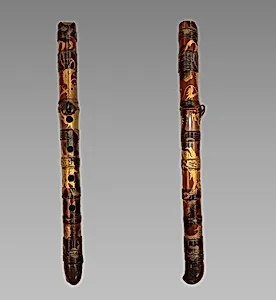
Medium
Wood, lacquer, gilt
Dimensions
L. ±14 9/16 × Diam. ±1 in. (±37 × ±2.6 cm) See Measurements photo for specific measurements
Classification
Aerophone-Reed Vibrated-double reed
Culture
Japanese
Department
Musical Instruments
Museum
Metropolitan Museum of Art, New York, NY
Credit
Gift of Mrs. Howard Mansfield, 1948
Accession Number
48.126.4
Rights
Public Domain
About this artwork
This hitoyogiri represents early 17th-century Japanese musical instrument craftsmanship, attributed to the renowned maker Ōmori Sōkun. The hitoyogiri is a vertical bamboo flute with five finger holes, used primarily in Zen Buddhist practice and secular music during the Edo period. The name derives from "hito" (one) and "yo" (joint), indicating the instrument is made from a single section of bamboo between nodes. This example, measuring approximately 14.5 inches in length, features lacquer decora...
Art Historical Context
This elegant hitoyogiri, attributed to the celebrated maker Ōmori Sōkun, exemplifies the refined craftsmanship of early seventeenth-century Japan. Crafted from a single section of bamboo, the instrument measures just over fourteen inches and features five finger holes along with decorative lacquer and gilt accents. These embellishments transform a functional musical tool into a work of art, reflecting the high regard for instrument makers during the Edo period. Historically, the hitoyogiri played a vital role in both Zen Buddhist meditation and secular music. Its name, meaning “one joint,” refers to the bamboo segment between nodes, and its airy, meditative tone suited the wandering komusō monks who used similar flutes in their spiritual practice. Attributions to Sōkun’s workshop signal exceptional quality, as his instruments bridged religious devotion and courtly entertainment. Acquired by the Metropolitan Museum in 1948 through the generosity of Mrs. Howard Mansfield, this piece highlights how musical instruments served as cultural artifacts. The lacquer surface not only protects the bamboo but also invites subtle decorative artistry, underscoring the deep connection between music, spirituality, and aesthetics in Japanese tradition.