
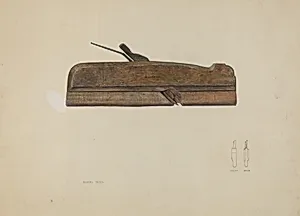
Hollow Plane
c. 1937
Medium
watercolor and graphite on paper
Dimensions
overall: 24.2 x 33.9 cm (9 1/2 x 13 3/8 in.) Original IAD Object: 2" high; 7 1/2" long
Classification
Index of American Design
Department
CG-W
Museum
National Gallery of Art, Washington, D.C.
Credit
Index of American Design
Accession Number
1943.8.13308
Rights
Public Domain
Art Historical Context
**Hollow Plane** by Samuel Faigin, created around 1937, is a meticulous and graphite rendering on paper, measuring 24.2 x 33.9 cm. This delicate work captures a compact woodworking tool—a hollow plane, originally just 2 inches high and7½ inches long—used by craftsmen to shape concave surfaces in wood. Faigin's precise lines and subtle color washes highlight the tool's ergonomic form, worn patina, and functional elegance, transforming an everyday object into a study of American ingenuity. As part of the *Index of American Design* (IAD), a Works Progress Administration (WPA) project from 1935 to 1942, this piece reflects a New Deal-era effort to document and celebrate the nation's folk art, crafts, and design heritage amid the Great Depression. Artists like Faigin, employed through the Federal Art Project, produced over 15,000 such watercolors to preserve vanishing traditions for future generations. Housed in the National Gallery of Art's collection, it underscores the IAD's role in fostering national pride and cultural documentation. The medium's transparency and fluidity suit the IAD's goal of faithful reproduction, blending technical accuracy with artistic sensitivity. This hollow plane evokes early American woodworking practices, reminding us of the skilled hands behind our built environment. A testament to both utility and artistry, it invites visitors to appreciate the unsung beauty in tools that shaped a nation.