
Honden
after 1583
Medium
engraving
Dimensions
208; 87
Rights
Public Domain
About this artwork
gravure
Art Historical Context
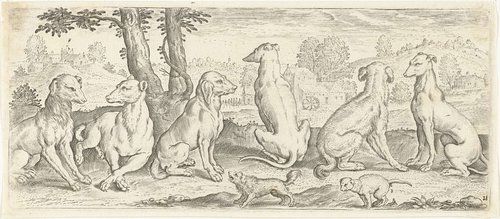
**Honden** by Abraham de Bruyn is a finely wrought engraving from after 1583, measuring 208 mm wide by 87 mm high. Created in Antwerp during the late Northern Renaissance, this print showcases de Bruyn's expertise as a Flemish engraver and publisher. Known for his detailed reproductive prints in books on heraldry, costumes, and natural subjects, de Bruyn employed the engraving technique—incising lines into a copper plate, inking the grooves, and pressing paper onto the surface—to achieve remarkable precision and tonal depth. Engravings like *Honden* ("Dogs" in Dutch) were pivotal in 16th-century Europe, enabling the widespread sharing of images before photography. This elongated format hints at its possible inclusion in a series, allowing viewers to appreciate the subtle textures of fur and form through cross-hatching and fine lines. De Bruyn's work bridged art and documentation, capturing everyday motifs with artistic flair amid the cultural vibrancy of the Spanish Netherlands. Today, *Honden* invites us to marvel at how such modest prints preserved fleeting moments of life, reflecting humanity's enduring bond with animals in an era of exploration and print innovation.