
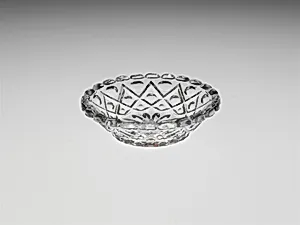
Honey Dish
Unknown Artist
1850–60
Medium
Pressed glass, diamond thumbprint
Dimensions
Diam. 3 1/2 in. (8.9 cm)
Classification
Honey Dish
Culture
American
Department
The American Wing
Museum
Metropolitan Museum of Art, New York, NY
Credit
Gift of Mrs. Emily Winthrop Miles, 1946
Accession Number
46.140.82
Rights
Public Domain
Art Historical Context
This delicate honey dish, crafted in pressed glass between 1850 and 1860, exemplifies the ingenuity of mid-19th-century American glassmaking. Measuring just 3½ inches in diameter, its compact form was designed for practical tabletop use, holding a small portion of honey while adding a touch of elegance to everyday meals. The "diamond thumbprint" pattern—characterized by raised, jewel-like motifs resembling fingerprints pressed into the glass—creates a sparkling, textured surface that mimics the luxury of hand-cut crystal but at a fraction of the cost. Pressed glass emerged during America's Industrial Revolution, revolutionizing home decor by enabling mass production through molds and mechanical presses. Factories across New England produced thousands of such items, making refined designs accessible to the growing middle class. This anonymous example, gifted to the Metropolitan Museum of Art in 1946 by Mrs. Emily Winthrop Miles, reflects the era's blend of utility and ornamentation, housed today in The American Wing as a testament to vernacular craftsmanship. Though the artist remains unknown, the dish's survival highlights the durability of these functional beauties, now cherished as cultural artifacts of Victorian domestic life. Visitors can appreciate how such humble objects democratized beauty in 19th-century America.