
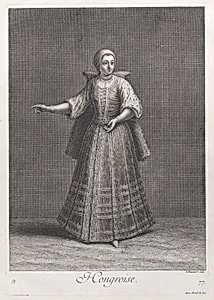
Hongroise, plate 77 from "Recueil de cent estampes représentent differentes nations du Levant"
Medium
Etching and engraving
Dimensions
Sheet: 16 1/2 × 12 1/16 in. (41.9 × 30.6 cm) Plate: 14 × 9 13/16 in. (35.5 × 24.9 cm)
Classification
Prints
Department
Drawings and Prints
Museum
Metropolitan Museum of Art, New York, NY
Credit
Bequest of Mrs. Charles Wrightsman, 2019
Accession Number
2019.282.70
Rights
Public Domain
Tags
Art Historical Context
This striking print, titled *Hongroise* (Hungarian Woman), is plate 77 from the celebrated 1714–15 volume *Recueil de cent estampes représentant différentes nations du Levant*. Created through etching and engraving after designs by the Flemish artist Jean Baptiste Vanmour, it belongs to an ambitious series documenting the peoples of the Ottoman Empire and surrounding regions. Vanmour, who lived in Constantinople for nearly two decades, produced vivid costume studies that became foundational references for European understandings of Eastern dress and customs. The work reflects the early eighteenth-century European fascination with the “Levant,” blending ethnographic curiosity with artistic elegance. Though titled “Hungarian,” the figure embodies the fluid cultural boundaries of the period, when regions under Ottoman influence shared richly layered textile traditions. Fine lines capture the intricate folds of her gown, headdress, and accessories, demonstrating how printmaking allowed such details to reach a wide audience across Europe. Today housed in the Metropolitan Museum of Art’s Department of Drawings and Prints, this sheet offers modern viewers a window into both historical costume and the collaborative print culture that shaped Western perceptions of the East.
About the Artist
Jacques le Hay|Jean Baptiste Vanmour (French| ) · 1671 |1650 –1737 |1750
French, Valenciennes 1671–1737 Istanbul (Constantinople)|