
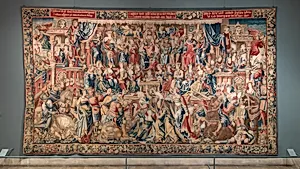
Honor from the series "The Honors"
designed before 1520, woven between 1525 and 1532
Medium
Wool and silk (wefts); wool (warps): 6-7 warp threads per cm.
Dimensions
confirmed: 15 ft. 2 1/16 in. × 26 ft. 2 9/16 in. (462.5 × 799 cm)
Classification
Textiles-Tapestries
Culture
Netherlandish, probably Brussels
Department
European Sculpture and Decorative Arts
Museum
Metropolitan Museum of Art, New York, NY
Credit
Purchase, 2014 Benefit and Director’s Funds, several members of The Chairman's Council Gifts, Brooke Russell Astor Bequest, Ambassador and Mrs. W. L. Lyons Brown, Mr. and Mrs. Richard L. Chilton Jr., and Josephine Jackson Foundation Gifts, 2015
Accession Number
2015.396
Rights
Public Domain
Tags
Art Historical Context
Step into the opulent world of Renaissance tapestries with *Honor*, a magnificent piece from Bernard van Orley's series "The Honors." Designed by this leading Netherlandish artist before 1520 and woven in Brussels between 1525 1532, it the height of Flemish tapestry production. Van Orley, a master and designer, created intricate cartoons that weavers brought to life, blending Italian Renaissance influences with Northern detail in scenes featuring horses, men, women—likely allegorizing the virtue of Honor in a grand procession. Crafted from wool and silk wefts on wool warps with a fine 6-7 threads per centimeter, this tapestry boasts exceptional quality and durability, intended to adorn the vast walls of palaces or noble halls. Measuring over 15 by 26 feet, its immense scale allowed it to transform entire rooms into immersive narratives of moral and chivalric ideals. Brussels workshops were Europe's premier tapestry centers, exporting these luxurious textiles to courts across the continent, symbolizing wealth and piety. Acquired by The Metropolitan Museum of Art in 2015, *Honor* highlights the enduring allure of 16th-century decorative arts, where artistry met patronage in celebrating human virtues amid the era's political and cultural splendor.