
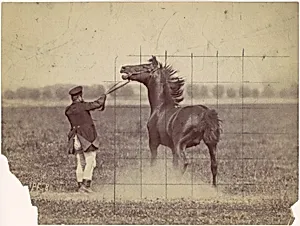
Horse
1884
Medium
Albumen silver print
Classification
Photographs
Department
Photographs
Museum
Metropolitan Museum of Art, New York, NY
Credit
Purchase, The Horace W. Goldsmith Foundation Gift, through Joyce and Robert Menschel, 1992
Accession Number
1992.5013
Rights
Public Domain
Tags
Art Historical Context
In 1884, German photographer Ottomar Anschütz *Horse*, an albumen silver print that exemplifies the era's fascination with motion in photography. Produced via a glass negative coated in egg white (albumen) and sensitized with silver salts, this medium delivered the sharp detail and rich tonal range essential for revealing fleeting moments previously invisible to the naked eye. Housed in the Metropolitan Museum of Art's Photographs department, the image likely features a horse—and possibly a rider—frozen mid-stride, drawing from Anschütz's pioneering chronophotography experiments. Anschütz, a key figure in late 19th-century scientific imaging, used innovative electric spark lighting to achieve exposures as short as 1/1000th of a second. His work built on Eadweard Muybridge's sequential horse studies, settling debates about equine gaits during a gallop—proving all four hooves briefly leave the ground. This photograph reflects the convergence of art and science, bridging photography's documentary roots with emerging motion picture technology. *Horse* invites visitors to ponder how such images revolutionized visual culture, influencing everything from painting to early cinema. A testament to human ingenuity, it reminds us that art often gallops ahead of our perceptions.