
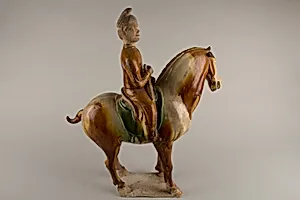
唐 三彩陶騎馬俑|Horse and rider
Unknown Artist
7th–8th century
Medium
Earthenware with three color (sancai) glaze
Dimensions
H. 16 3/4 in. (42.5 cm); W. 5 5/8 in. (14.3 cm); L. 14 3/4 in. (37.5)
Classification
Tomb Pottery
Culture & Period
China · Tang dynasty (618–907)
Department
Asian Art
Museum
Metropolitan Museum of Art, New York, NY
Credit
Gift of Rosina O. Bateson, 1965
Accession Number
65.101.4
Rights
Public Domain
Tags
Art Historical Context
This vibrant horse and rider figurine, crafted in the Tang dynasty (618–907 exemplifies the era's masterful sancai pottery—a low-fired earthenware glazed in signature tri-color splashes of amber-yellow, green, and creamy white. Standing about 16¾ inches tall, the piece captures a dynamic rider atop a sturdy steed, both rendered with lively realism that reflects Tang China's cosmopolitan spirit. Horses, symbols of power and mobility influenced by Silk Road exchanges, were elite status markers, often buried as mingqi (spirit objects) to accompany the deceased into the afterlife. Produced between the 7th and 8th centuries, this tomb pottery hails from a golden age of artistic innovation, when Tang artisans perfected sancai glazes through lead-oxide formulas that yielded fluid, iridescent drips. The technique not only highlighted the horse's muscular form and the rider's poised stance but also evoked the dynasty's equestrian prowess and cultural openness to Central Asian motifs. Such figures, common in elite burials, offered practical service in the tomb while celebrating life's vitality. Today, gifted to the Metropolitan Museum of Art in 1965, this unknown artist's work invites us to marvel at Tang ingenuity—bridging the mortal world and eternity through enduring color and form.