
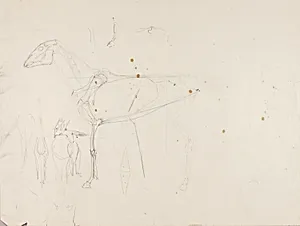
Horse
1916
Medium
Drawing
Classification
Drawing
Department
Smithsonian Collection
Museum
Smithsonian American Art Museum
Credit
Smithsonian American Art Museum, Gift of Mr. and Mrs. A. Mervyn Davies
Accession Number
1971.446.2
Rights
Public Domain
Tags
Art Historical Context
Solon H. Borglum, a leading American sculptor renowned for his dynamic depictions of Western life and equine subjects, created *Horse* in 1916 as a preparatory drawing. Born in 1868, Borglum was part of a prominent artistic family—his brother Gut famously carved Mount Rushmore—and he excelled in capturing the power and anatomy of horses, often for monumental sculptures. This work, housed in the Smithsonian American Art, reflects the early 20th-century fascination with realism in American art, amid the rise of the Western genre that celebrated frontier spirit during World War I. Rendered as an anatomical and sculpture study, the drawing showcases Borglum's meticulous technique in pencil or charcoal, emphasizing the horse's musculature, proportions, and movement. Such studies were essential for sculptors transitioning from two dimensions to three, ensuring lifelike bronze or marble forms. Tags like "horse" and "anatomical study" highlight its role in honing precision, a hallmark of Borglum's Beaux-Arts training and his contributions to public monuments, including equestrian statues. Today, *Horse* offers visitors a glimpse into an artist's process, bridging drawing's intimacy with sculpture's grandeur. Donated by Mr. and Mrs. A. Mervyn Davies, it underscores the Smithsonian's commitment to preserving American creative legacies.