
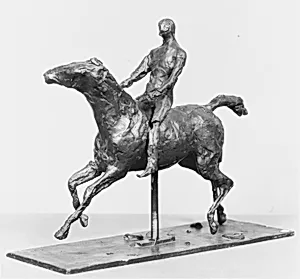
Horse with Jockey; Horse Galloping, Turning the Head to the Right, the Feet Not Touching the Ground
modeled perhaps before ca. 1879, cast 1920
Medium
Bronze
Dimensions
11-1/4 x 14-1/2 x 5-3/16 in. (28.6 x 36.8 x 13.2 cm.)
Classification
Sculpture-Bronze
Culture
French
Department
European Sculpture and Decorative Arts
Museum
Metropolitan Museum of Art, New York, NY
Credit
H.O. Havemeyer Collection, Bequest of Mrs. H.O. Havemeyer, 1929
Accession Number
29.100.436a, b
Rights
Public Domain
Tags
Art Historical Context
Edgar Degas, a leading French Impressionist, captured the raw energy of horse racing in this dynamic bronze sculpture, *Horse with Jockey; Horse Galloping, Turning the Head to the Right, the Feet Not Touching the Ground*. Modeled likely before 1879—possibly in wax, as was Degas' practice—and cast in 1920 by A.-A. Hébrard et Cie after the artist's death, it measures 11¼ x 14½ x 5³⁄₁₆ inches. Degas frequented Paris racetracks, sketching jockeys and horses to study their anatomy and motion, influenced by early photography that froze fleeting moments. This work exemplifies Degas' revolutionary approach to sculpture, emphasizing immediacy over classical poise. The horse's airborne gallop, head twisted right, conveys mid-stride suspension, showcasing his fascination with equine movement akin to his ballet dancers. Bronze casting preserved these fragile originals, ensuring their legacy; this piece entered the Metropolitan Museum of Art via the H.O. Havemeyer Collection in 1929. A testament to Degas' blend of observation and innovation, it highlights 19th-century French artistry's shift toward modernity, inviting viewers to feel the thrill of the racetrack.
About the Artist
Edgar Degas|A.-A. Hébrard et Cie · 1834–1917
Edgar Degas (1834-1917) stands as one of the most innovative artists of the nineteenth century, whose distinctive vision transformed how modern life could be depicted on canvas. Born Hilaire-Germain-Edgar De Gas in Paris to a wealthy banking family—his father French, his mother a Louisiana Creole from New Orleans—Degas received a classical education before abandoning law studies in 1855 to pursue ...