
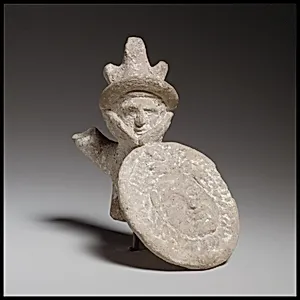
Horseman
Unknown Artist
early 3rd century BCE
Medium
Terracotta
Dimensions
H. 4 1/16 in. (10.3 cm)
Classification
Terracottas
Culture & Period
Cypriot · Early Hellenistic
Department
Greek and Roman Art
Museum
Metropolitan Museum of Art, New York, NY
Credit
The Cesnola Collection, Purchased by subscription, 1874–76
Accession Number
74.51.1659
Rights
Public Domain
Tags
Art Historical Context
This charming terracotta figurine, titled *Horseman*, captures a dynamic male rider—likely a warrior clutching a shield—in the vibrant world of Early Hellenistic Cyprus around the early 3rd century BCE. Standing just over 4 inches (10.3 cm) tall, its modest scale belies its lively presence, with the rider's poised stance evoking the speed and valor of ancient cavalry. Terracotta, a fired clay medium, was ideal for Cypriot artisans, allowing mass production of affordable sculptures through molds. These small votive figures graced sanctuaries, tombs, and households, offering prayers for protection or celebrating martial prowess amid the Hellenistic era's cultural fusion—Greek influences blending with local traditions under Ptolemaic rule following Alexander the Great's conquests. Horsemen like this one symbolized mobility and heroism, reflecting Cyprus's strategic island role in Mediterranean trade and warfare. Acquired as part of the Cesnola Collection (purchased by subscription, 1874–76), this piece now resides in the Metropolitan Museum of Art's Greek and Roman Art Department, inviting us to ponder the everyday devotion and artistry of an ancient Cypriot world.