
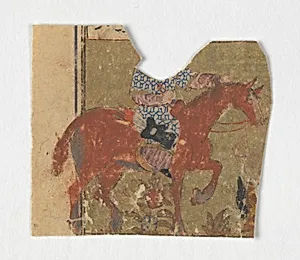
"Horseman and Fragment of Text", Folio from a Shahnama (Book of Kings)
ca. 1330–40
Medium
Ink, opaque watercolor, and gold on paper
Dimensions
H. 1 3/4 in. (4.4 cm) W. 2 in. (5.1 cm)
Classification
Codices
Department
Islamic Art
Museum
Metropolitan Museum of Art, New York, NY
Credit
Purchase, Gifts in memory of Richard S. Perkins, and funds from various donors, 2003
Accession Number
2003.330.7
Rights
Public Domain
Tags
Art Historical Context
This exquisite folio, titled *Horseman and Fragment Text*, comes from a *Shahnama* (Book of Kings), the monumental Persian epic poem composed by Abu'l Qasim Firda around 1010 CE. Dating to circa 1330–40, it hails from the Ilkid period in Persia, when Mongol rulers patronized a renaissance of manuscript illumination blending Persian traditions with subtle Chinese influences. At just 1¾ × 2 inches, this tiny gem captures a dynamic horseman amid swirling energy, paired with elegant calligraphy—a fragment of Firdausi's verse—evoking heroic tales of ancient kings, battles, and legends central to Persian identity. Crafted with ink, opaque watercolor, and gold on paper, the work exemplifies Persian miniature painting's mastery. The gold heightens drama, illuminating the rider and steed in vivid hues, while fine lines convey motion and intricate details like flowing garments and horse's musculature. Such codices were prized treasures, often disassembled over centuries for their individual folios, preserving epic narratives for elite audiences. Today, housed in the Metropolitan Museum of Art's Islamic Art Department, this piece invites us into a world where poetry and image intertwined to celebrate cultural heritage, reminding visitors of the *Shahnama*'s enduring role as Iran's national epic.
About the Artist
Abu'l Qasim Firdausi · 935–1020
Abu'l Qasim Firdausi, born around 940 in the village of Paj near Tus in Khorasan (modern-day Iran), emerged from a family of landed gentry known as dehqans, who preserved ancient Iranian oral traditions amid the cultural renaissance of the Samanid Empire. Little is documented about his early life or formal training, though he likely received a basic education including Arabic literacy, immersing h...