
Medium
etching on Japanese paper
Dimensions
plate: 20.1 × 14.1 cm (7 15/16 × 5 9/16 in.) sheet: 31.1 × 22.7 cm (12 1/4 × 8 15/16 in.)
Classification
Department
CG-E
Museum
National Gallery of Art, Washington, D.C.
Credit
Rosenwald Collection
Accession Number
1952.8.255
Rights
Public Domain
Art Historical Context
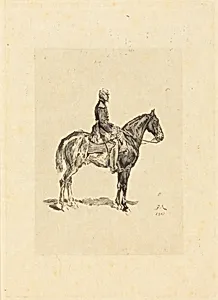
Discover the intricate "Horseman," an 1861 etching by French artist Frédéric Auguste La Guillermie, reproducing a composition by the renowned painter Jean-Louis-Eest Meissonier. Meissonier, a master of Realism celebrated for his meticulous depictions of military figures and historical scenes, inspired this print during France's Second Empire era—a time when equestrian subjects evoked chivalry, warfare, and national pride. La Guillermie's skilled hand captures the dynamic energy of the rider, likely drawing from Meissonier's signature small-scale, hyper-detailed style that brought 17th-century soldiers to vivid life. Printed on fine Japanese paper, a luxurious choice prized by 19th-century printmakers for its absorbency and texture, the etching measures a compact plate size of 20.1 × 14.1 cm (7 15/16 × 5 9/16 in.), with a larger sheet of 31.1 × 22.7 cm (12 1/4 × 8 15/16 in.). Etching's intaglio technique allowed La Guillermie to replicate Meissonier's precision—fine lines evoking movement, shadow, and texture—making high art accessible through affordable prints. This reproductive work highlights the era's booming print market, bridging painting and graphic arts. Housed in the National Gallery of Art's Rosenwald Collection (Department CG-E), "Horseman" exemplifies 19th-century technical virtuosity and cultural fascination with heroic equestrian themes. A delightful gem for print enthusiasts!