
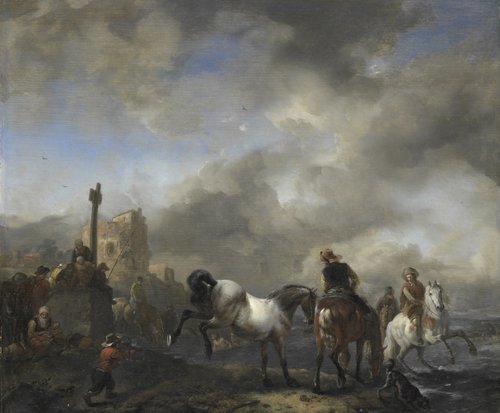
Horsepond near a Boundary Stone
ca. 1651 - ca. 1654
Medium
oil on panel
Dimensions
41.2; 5.5; 35.5
Rights
Public Domain
About this artwork
signatuur, met monogram, linksonder (letters van de voornaam in ligatuur): ‘PHiLs:W’ in monogram
Art Historical Context
Philips Wouwerman’s *Horsepond near a Boundary Stone* captures a tranquil rural moment from the Dutch Golden Age. Painted between about 1651 and 1654, the small oil-on-panel work invites viewers to pause beside a quiet watering place marked by a weathered boundary stone. Wouwerman, celebrated for his lively yet harmonious landscapes, often included horses as central figures; here they suggest the daily rhythms of travel, trade, and countryside life in the young Dutch Republic. The compact format—only 35.5 by 41.2 centimetres—highlights the artist’s skill with the oil medium on panel. Fine brushwork renders the reflective water, textured stone, and soft sky with remarkable clarity, a technique that allowed seventeenth-century collectors to enjoy intricate detail in modest domestic spaces. The discreet monogram “PHiLs:W” tucked in the lower left confirms Wouwerman’s authorship and places the painting firmly within his mature period of production. Displayed today at the Rijksmuseum, the work offers modern visitors a window onto the Dutch fascination with their own landscape. Rather than grand history scenes, Wouwerman celebrates the ordinary beauty of fields, paths, and animals, reminding us how closely art and everyday surroundings were intertwined in the seventeenth century.
About the Artist
Philips Wouwerman · 1619–1668
Specialized in military and hunting scenes in which horses are prominent. Son of a little known painter in Alkmaar, Paul Joosten Wouwerman. Philips died at the age of 48 reportedly as the result of an accident, having created a large number of landscapes, battle scenes and the elegant life of his time, set in castles, parties, hunting, huntsmen and prized horses.