
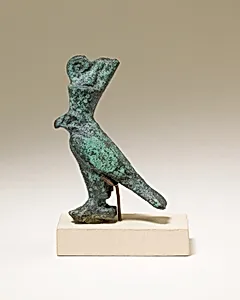
Horus falcon in double crown
Unknown Artist
664–30 B.C.
Medium
Cupreous metal
Dimensions
H. 5.4 cm (2 1/8 in.); W. 1.6 cm (5/8 in.); L. 3.5 cm (1 3/8 in.) H. (with tang): 5.9 cm (2 5/16 in.)
Classification
Figurine, falcon
Period
Late Period–Ptolemaic Period
Department
Egyptian Art
Museum
Metropolitan Museum of Art, New York, NY
Credit
Funds from various donors, 1886
Accession Number
86.1.72
Rights
Public Domain
Tags
Art Historical Context
This small but striking figure represents Horus, the falcon-headed god of kingship and the sky, wearing the double crown that symbolized the unification of Upper and Lower Egypt. Created between 664 and 30 B.C. during Egypt’s Late and Ptolemaic Periods, the sculpture belongs to a long tradition of votive offerings placed in temples to honor the divine protector of the pharaoh. Its modest size—just over five centimeters tall—suggests it was likely intended for personal devotion or temple dedication rather than grand public display. Crafted from cupreous metal, a copper alloy favored in Egyptian workshops for its durability and ability to take fine detail, the falcon’s alert posture and carefully modeled crown convey both power and elegance. A short tang beneath the figure indicates it was once fitted into a wooden base or shrine, allowing worshippers to carry or position it during rituals. Such portable images kept the presence of Horus close at hand, reinforcing the god’s role as guardian of the ruler and guarantor of cosmic order. Today housed in the Metropolitan Museum of Art’s Egyptian Art department, this falcon reminds us how even the smallest works of art carried profound religious and political meaning, linking everyday piety with the enduring ideals of Egyptian kingship.