
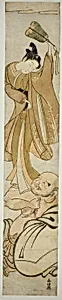
Hotei Balances a Young Man on His Arm
c. early 1770s
Medium
Color woodblock print; hashira-e
Dimensions
63.5 × 11.8 cm (25 × 4 5/8 in.)
Classification
woodblock print
Department
Arts of Asia
Museum
Art Institute of Chicago
Accession Number
13317
Rights
Public Domain
Art Historical Context
Behold the delightful *Hotei Balances a Young Man on His*, a color woodblock print (hashira-e) by the Japanese artist Masunobu, created around the early 1770s. Measuring a slender 63.5 × 11.8 cm, this vertical "pillar print" was designed to hang on architectural pillars in homes or teahouses, a format that highlights its elongated composition and intimate scale. Housed in the Art Institute of Chicago Arts of Asia department, exemplifies the vibrant ukiyo-e tradition of Edo-period Japan, where everyday life and folklore merged in accessible art. At its heart is Hotei, one of the beloved Seven Lucky Gods (Shichifukujin), portrayed as a rotund, joyful monk with a sack of treasures symbolizing prosperity and good fortune. Here, Masunobu captures Hotei's superhuman strength and playful spirit as he effortlessly balances a young man on his outstretched arm—a whimsical scene blending humor, physical prowess, and spiritual benevolence. Such depictions were popular in 18th-century Japan, reflecting folk beliefs in Hotei's protective, laughter-filled presence. Masunobu's mastery shines in the precise woodblock technique, layering vibrant colors through multiple carved blocks to achieve rich hues and subtle gradients typical of the era's evolving nishiki-e ("brocade pictures"). Rare among surviving hashira-e due to their fragility, this print offers a window into urban Japan's cultural joie de vivre, inviting us to smile at its lighthearted charm.