
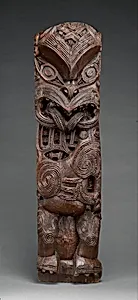
House Post Figure (Amo)
Unknown Artist
ca. 1800
Medium
Wood
Dimensions
H. 43 × W, 11 × D. 5 in. (109.2 × 27.9 × 12.7 cm)
Classification
Wood-Architectural
Culture
Maori people, Te Arawa
Department
Arts of Africa, Oceania, and the Americas
Museum
Metropolitan Museum of Art, New York, NY
Credit
The Michael C. Rockefeller Memorial Collection, Bequest of Nelson A. Rockefeller, 1979
Accession Number
1979.206.1508
Rights
Public Domain
Art Historical Context
This striking **House Post Figure (A)**, carved around 1800 by an unknown Maori artist of the Te Arawa people, stands as a testament to New Zealand's indigenous artistic mastery. Measuring over 3 feet tall, this wooden architectural element once supported the ridge beam of a traditional Maori meeting house (*wharenui*), embodying spiritual and structural heart of communal life. Te Arawa, one of the major iwi (tribes), are renowned for their elaborate wood carvings that weave genealogy, mythology, and identity into every groove. In Maori culture, *amo* figures like this one often depict ancestors or supernatural guardians, their fierce expressions and dynamic poses warding off evil while honoring tupuna (ancestors). Crafted from native timber using stone adzes before metal tools arrived, the sculpture showcases classic *whakairo* techniques: deeply incised spirals (*koru*), interlocking forms, and manaia profiles blending human, bird, and reptilian traits. These motifs symbolize life's interconnected cycles, fertility, and whakapapa (genealogy). Acquired through The Michael C. Rockefeller Memorial Collection at The Metropolitan Museum of Art, this *amo* invites visitors to ponder the enduring power of Maori artistry—bridging past and present in the Arts of Africa, Oceania, and the Americas.