
Hume Cash Register
c. 1939
Medium
watercolor, graphite, and pen and ink on paperboard
Dimensions
overall: 49.6 x 39.9 cm (19 1/2 x 15 11/16 in.) Original IAD Object: 21" high; base: 17" wide; 13" deep; 4 1/2" high; top section: 16 5/8" high; 15 1/2" wide; 6" thick
Classification
Index of American Design
Department
CG-W
Museum
National Gallery of Art, Washington, D.C.
Credit
Index of American Design
Accession Number
1943.8.9153
Rights
Public Domain
Art Historical Context
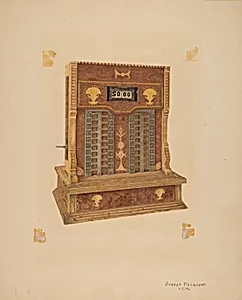
This watercolor, graphite, and pen-and-ink rendering a Hume Cash Register was created by Ficcadenti around 193 as part of the Index American Design. That New Deal project, carried under the Works Progress Administration, employed artists document the nation’s decorative arts, folk crafts, and everyday objects with scientific precision. Ficcadenti’s drawing belongs to this visual archive, capturing an object that once stood 21 inches high and embodied the sturdy, ornate aesthetic of early commercial equipment. The combination of media allowed the artist to record both the cash register’s architectural form and its surface details—metalwork, lettering, and mechanical features—with remarkable fidelity. Such renderings served as permanent records at a time when many historic objects risked being discarded or lost. They also celebrated American ingenuity in industrial design, showing how even utilitarian devices like cash registers reflected craftsmanship and period style. Today the work offers museum visitors a window onto two intertwined histories: the evolution of retail technology and the Depression-era effort to preserve American material culture. It reminds us that ordinary objects, when carefully observed and recorded, become valuable documents of daily life and national identity.