
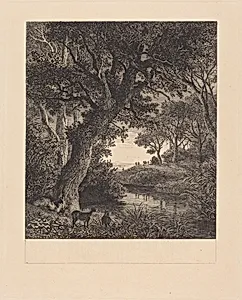
Hunters Leaving a Forest
1801 to 1825
Medium
etching on beige wove paper (proof)
Dimensions
plate: 28.4 x 22.7 cm (11 3/16 x 8 15/16 in.) sheet: 44.7 x 30.4 cm (17 5/8 x 11 15/16 in.)
Classification
Department
CG-E
Museum
National Gallery of Art, Washington, D.C.
Credit
Ailsa Mellon Bruce Fund
Accession Number
1998.16.1
Rights
Public Domain
Art Historical Context
Johann Wilhelm Schirmer's *Hunters Leaving a Forest*, created between 1801 and 1825, captures the quiet drama of human figures emerging from a dense woodland in this delicate etching on beige wove. As a proof impression, it represents an early trial state of the print, offering visitors a rare glimpse into the artist's iterative process before the final edition. Measuring 28.4 x 22.7 cm on the plate, the work exemplifies Schirmer's mastery of Romantic landscape art, evoking the sublime beauty and mystery of nature during Germany's early 19th-century artistic renaissance. Schirmer, a prominent German painter and printmaker associated with the Düsseldorf school, specialized in intricate forest scenes that celebrated nature's untamed power. Etching, an intaglio technique where acid etches lines into a metal plate for inked impressions, allowed him to achieve fine textures—from dappled leaves to misty depths—that mimic oil painting's richness on paper. This proof, now in the National Gallery of Art's Prints department thanks to the Ailsa Mellon Bruce Fund, highlights the era's fascination with the hunt as a metaphor for humanity's harmonious (or tense) coexistence with the wild. For museum-goers, this piece invites reflection on Romantic ideals, where humble hunters underscore nature's dominance, blending technical precision with poetic atmosphere.