
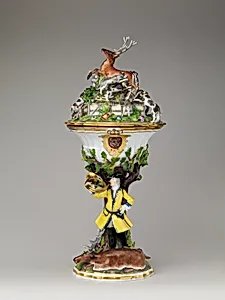
Hunting cup with cover
Medium
Hard-paste porcelain
Dimensions
Overall (confirmed): 14 11/16 x 5 3/4 x 6 in. (37.3 x 14.6 x 15.2 cm); Overall ht. of cup (confirmed): 9 3/16 in. (23.3 cm)
Classification
Ceramics-Porcelain
Culture
German, Meissen
Department
European Sculpture and Decorative Arts
Museum
Metropolitan Museum of Art, New York, NY
Credit
The Lesley and Emma Sheafer Collection, Bequest of Emma A. Sheafer, 1973
Accession Number
1974.356.337a, b
Rights
Public Domain
Tags
Art Historical Context
This exquisite *Hunting Cup with Cover*, crafted around 1741 by Johann Joachim Känd at the renowned Meissen Manufactory exemplifies the pinnacle of 18th European porcelain artistry. Meissen, the first European producer of hard-paste porcelain—a durable, translucent material rivaling Chinese imports—revolutionized decorative arts under August the Strong's patronage. Kändler, Meissen's chief modeler, brought dynamic Rococo flair to his designs, blending intricate modeling with vibrant overglaze enameling. Adorned with lively hunting motifs including deer, dogs, musical instruments like hunting horns, and a prominent coat of arms, the cup evokes the aristocratic pursuits of the Saxon elite. Standing at nearly 15 inches tall overall, its sculptural form—complete with a domed cover—served as both functional vessel and display piece, ideal for toasting during hunts or lavish banquets. The detailed figural scenes showcase Kändler's mastery in capturing motion and realism on porcelain, a technically demanding feat involving meticulous molding, firing, and hand-painting. A gift from the Lesley and Emma Sheafer Collection to the Metropolitan Museum of Art, this piece highlights Meissen's cultural prestige, symbolizing wealth, craftsmanship, and the era's fascination with nature's drama. Visitors, imagine the clink of porcelain amid forest echoes!