
Hunting Knife with Sheath
Unknown Artist
16th–19th century
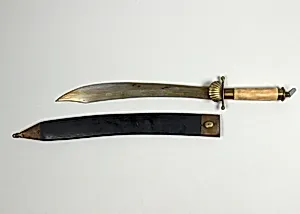
Medium
Steel, bone, wood
Dimensions
L. with sheath 21 1/4 in. (54 cm); L. without sheath 18 in. (45.7 cm); L. of blade 13 in. (33 cm); W. 2 1/2 in. (6.4 cm); Wt. 12.4 oz. (351.5 g); Wt. of sheath 2.6 oz. (73.7 g)
Classification
Knives
Culture
Javanese
Department
Arms and Armor
Museum
Metropolitan Museum of Art, New York, NY
Credit
Bequest of George C. Stone, 1935
Accession Number
36.25.1005a, b
Rights
Public Domain
Art Historical Context
This exquisite Javanese hunting knife with sheath, dating from the 16th 19th century, exemplifies the practical artistry of Southeast Asian craftsmanship. Crafted from steel for the 13-inch blade, with a handle and sheath of bone and wood, it measures 21¼ inches long with its sheath and weighs just over a pound. Housed in the Metropolitan Museum of Art's Arms and Armor Department, it entered the collection through the 1935 bequest of George C. Stone, a renowned collector of global weaponry. In Javanese culture, such knives were essential tools for hunting and survival in Indonesia's lush landscapes, blending utility with subtle elegance. The choice of materials—durable steel for cutting power, lightweight bone and wood for grip and protection—highlights the ingenuity of anonymous artisans who prioritized balance and functionality. Spanning centuries of Java's dynamic history, from Islamic sultanates to Dutch colonial influence, this piece reflects how edged weapons served not just practical needs but also cultural identity and status. Visitors will appreciate its preserved condition, offering a tangible link to the everyday lives of Javanese hunters and warriors, where form met fierce necessity.