
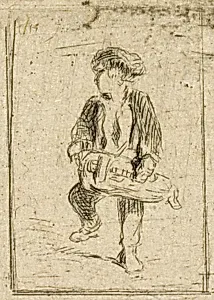
Hurdy-Gurdy Player
c. 1843
Medium
Drypoint and roulette on ivory wove paper
Dimensions
Plate: 9.1 × 10.9 cm (3 5/8 × 4 5/16 in.); Sheet: 11.1 × 13.5 cm (4 3/8 × 5 3/8 in.)
Classification
drypoint
Department
Prints and Drawings
Museum
Art Institute of Chicago
Accession Number
194191
Rights
Public Domain
Art Historical Context
Charles Émile Jacque *Hurdy-Gurdy Player* (c. 1843) captures the humble charm of rural French life, a recurring theme in the artist's oeuvre. A member of the Barbizon School, Jacque renowned for his evocative depictions of peasants, animals, and countryside scenes, blending Realism with a touch of Romantic nostalgia. Here, the itinerant musician with his distinctive hurdy-gurdy—a medieval string instrument played by cranking a wheel—embodies the wandering folk traditions of 19th-century Europe, evoking both melody and melancholy. Printed in drypoint and roulette on fine ivory wove paper, this intimate work (plate: 9.1 × 10.9 cm) showcases Jacque's mastery of printmaking. Drypoint involves scratching directly into a copper plate, producing rich, velvety lines from the burr that softens edges and adds texture, while the roulette tool creates tonal effects like fur or fabric through wheeled indentations. These techniques allowed for subtle gradations and atmospheric depth, making the small-scale print feel vividly alive—perfect for collectors in an era when affordable prints democratized art. Housed in the Art Institute of Chicago's Prints and Drawings department, this piece highlights Jacque's transition from painting to etching, influencing later Realists. Imagine the faint squeak of the hurdy-gurdy echoing through a village square—Jacque invites us to pause and appreciate the unsung performers of everyday history.