
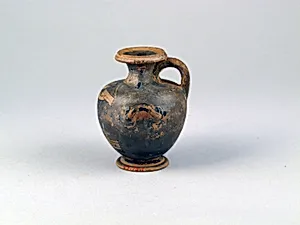
Hydria, miniature
Unknown Artist
5th century BCE
Medium
Terracotta
Dimensions
2 15/16 x 1 7/8in. (7.5 x 4.8cm) Other: 1 1/2in. (3.8cm) Other (width with handles): 1 7/8in. (4.8cm)
Classification
Vases
Culture & Period
Greek, Attic · Classical
Department
Greek and Roman Art
Museum
Metropolitan Museum of Art, New York, NY
Credit
Funds from various donors, 1923
Accession Number
23.73.1
Rights
Public Domain
Art Historical Context
This delicate miniature hydria, crafted in terracotta by an unknown Attic Greek artisan around the 5th century BCE, offers a glimpse into the refined world of Classical Athens. Standing just under 3 inches tall (7.5 cm) with a width of 1 7/8 inches (4.8 cm including handles), this tiny vessel exemplifies the precision of Greek pottery-making during the era of the Parthenon and Pericles' golden age. Hydriai—three-handled jars designed for carrying and pouring water—were everyday essentials in ancient households, but their miniature scale suggests special uses, such as votive offerings in sanctuaries or decorative items symbolizing domestic life. Attic pottery from this period was renowned for its technical mastery, with terracotta fired to a warm reddish hue and shaped on a potter's wheel. Though decoration details are not preserved here, such vases often featured black- or red-figure painting depicting myths, daily scenes, or rituals, reflecting Greece's vibrant cultural and religious life. This piece's small size highlights the potter's skill in scaling down functional forms without losing elegance. Now in the Metropolitan Museum of Art's Greek and Roman Art Department (acquired through donor funds in 1923), it invites us to marvel at how even the humblest objects embodied the harmony and innovation of Classical Greece.