
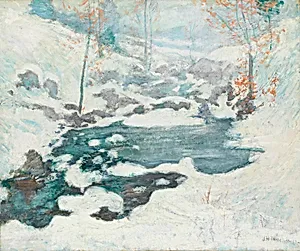
Icebound
John Henry Twachtman, c. 1889
About this artwork
John Henry Twachtman’s *Icebound* (c. 1889), an oil on canvas measuring 25 5/16 × 30 3/16 inches, captures the serene yet stark beauty of a winter landscape. As a leading figure in American Impressionism, Twachtman was renowned for his innovative approach to light and atmosphere, often painting en plein air to convey the fleeting effects of nature. This work, housed in the Art Institute of Chicago’s Department of Arts of the Americas, exemplifies his fascination with snow-covered scenes, where the title evokes a frozen river or shoreline locked in ice. Twachtman’s loose, textured brushwork in oils allows subtle gradations of white and cool tones to suggest depth and movement, breaking from the precise realism of earlier American landscape traditions. Created during the Gilded Age, when rapid industrialization contrasted with romanticized views of the American wilderness, *Icebound* reflects a cultural nostalgia for untouched nature. Its classification as a painting underscores the medium’s versatility for evoking mood over meticulous detail, inviting viewers to feel the chill and quiet isolation. A masterful study in subtlety, this piece highlights Twachtman’s role in adapting European Impressionism to American subjects, making it a gem for visitors exploring late 19th-century innovation in the museum’s collection.