
Ichikawa Omezo
1794
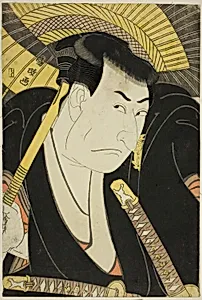
Medium
Color woodblock print; oban
Dimensions
37.3 × 25.4 cm (14 11/16 × 10 in.)
Classification
woodblock print
Department
Arts of Asia
Museum
Art Institute of Chicago
Accession Number
86969
Rights
Public Domain
Art Historical Context
Behold the striking portrait *Ichikawa Omezo* (1794), a masterpiece of ukiyo-e woodblock printing by Utagawa Kunimasa, a skilled artist from the renowned Utagawa school in Edo-period Japan. This oban-sized color woodblock print (37.3 × 25.4 cm) captures the dramatic likeness of Kabuki actor Ichikawa Omezo, likely in a dynamic theatrical pose that embodies the "floating world" of entertainment and fleeting beauty central to ukiyo-e culture. Kunimasa's technique exemplifies the artistry of nishiki-e, or "brocade pictures," where intricate woodblocks were carved separately for each color and layer, allowing vibrant hues and fine details to bring the actor's expressive face, flowing robes, and kimono patterns to life. Produced during the late 18th century, when Kabuki theater thrived in Edo (modern Tokyo), such yakusha-e (actor prints) were affordable souvenirs for fans, disseminating celebrity culture much like modern posters. Housed in the Art Institute of Chicago's Arts of Asia department, this print highlights ukiyo-e's global influence, inspiring later Western artists like Van Gogh. It invites us to step into Japan's vibrant theatrical past, where art and performance intertwined to celebrate human emotion and artistry.
About the Artist
Utagawa Kunimasa · 1773–1810
Utagawa Kunimasa (1773–1810) was a Japanese ukiyo-e artist specializing in yakusha-e, or Kabuki actor prints, during the late Edo period. Born in Aizu, Fukushima Prefecture in 1773, Kunimasa initially worked in a local dye factory for several years before pursuing his true passion. As an ardent Kabuki theatre enthusiast, he relocated to Edo (modern Tokyo) to establish himself as an artist capable ...