
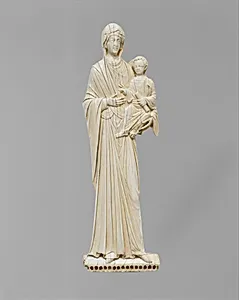
Icon with the Virgin and Child
Unknown Artist
mid-10th–mid-11th century
Medium
Ivory
Dimensions
Overall: 9 3/16 x 2 3/4 x 1/2in. (23.4 x 7 x 1.3cm)
Classification
Ivories
Culture
Byzantine
Department
Medieval Art
Museum
Metropolitan Museum of Art, New York, NY
Credit
Gift of J. Pierpont Morgan, 1917
Accession Number
17.190.103
Rights
Public Domain
Tags
Art Historical Context
This exquisite *Icon with the Virgin and Child*, from ivory in the Byzantine Empire during the mid-10th to mid-11th century, captures the tender devotion central to Eastern Orthodox Christianity. Measuring just 9 3/16 x 2 3/4 x 1/2 inches, its compact size suggests it was designed as a personal devotional object—perhaps a portable panel for private prayer or part of a larger liturgical ensemble. The unknown artist masterfully rendered the Madonna and Child in a style typical of Byzantine art, emphasizing spiritual hierarchy over naturalism, with elongated figures and serene expressions that invite contemplation. Ivory, a luxurious and durable medium prized in the medieval world, allowed for intricate carving that highlighted the icon's sacred aura. Sourced from elephant tusks traded across the Mediterranean, Byzantine ivories like this one were status symbols, often gifted to churches or nobility. This piece exemplifies the Middle Byzantine revival of classical techniques, blending Hellenistic influences with Christian iconography to affirm Mary's role as Theotokos, or "God-bearer." A generous gift from J. Pierpont Morgan to The Metropolitan Museum of Art in 1917, it now resides in the Medieval Art department, offering visitors a window into the enduring piety and artistic sophistication of Byzantium's golden age.