
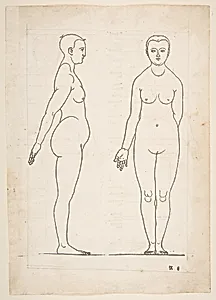
IIllustration from Dürers Vier Bucher von Menslicher Proportion, Nuremberg, 1528
1528
Medium
Woodcut
Classification
Prints
Department
Drawings and Prints
Museum
Metropolitan Museum of Art, New York, NY
Credit
Bequest of James Clark McGuire, 1930
Accession Number
31.54.108
Rights
Public Domain
Tags
Art Historical Context
Albrecht Dürer’s woodcut from *Four Books on Human Proportion* (1528) represents the culmination of the artist’s lifelong fascination with the human body as a subject of both art and science. Published in Nuremberg the year of his death, the treatise systematically explores ideal proportions through measured diagrams of male and female figures. This particular illustration, showing female nudes, demonstrates Dürer’s attempt to codify harmonious ratios that could guide artists across Europe. The woodcut medium was essential to Dürer’s project. Its crisp lines and reproducibility allowed precise anatomical details and measurement grids to reach a wide audience of painters, sculptors, and scholars. Drawing on both Northern Gothic traditions and Italian Renaissance theories of proportion, Dürer created a practical manual that bridged mathematics and aesthetics. Today this print in the Metropolitan Museum’s collection stands as a landmark in the history of anatomical study, illustrating how Renaissance artists used printmaking to transform empirical observation into enduring artistic knowledge.
About the Artist
Albrecht Dürer · 1471–1528
Albrecht Dürer (1471–1528) stands as the preeminent figure of the Northern Renaissance and arguably the most influential artist in the history of printmaking. Born in Nuremberg on May 21, 1471, and dying in the same city on April 6, 1528, Dürer revolutionized the status of the artist in Northern Europe, transforming printmaking from a commercial craft into an independent fine art and establishing ...