
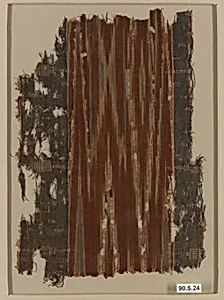
Ikat Textile Fragment
Unknown Artist
9th–10th century
Medium
Cotton; resist dyed (ikat), plain weave, brocaded
Dimensions
Textile: Max. H. 7 7/8 in. (20 cm) Max. W. 5 1/2 in. (14 cm) Mount: H. 12 5/8 in. (32.1 cm) W. 10 3/8 (26.4cm) D. 1 1/4 in. (3.2 cm)
Classification
Textiles-Woven
Department
Islamic Art
Museum
Metropolitan Museum of Art, New York, NY
Credit
Gift of George F. Baker, 1890
Accession Number
90.5.24
Rights
Public Domain
Art Historical Context
This exquisite Ikat Textile Fragment, to the 9th–10th century, offers glimpse into the sophisticated world Islamic textile artistry during theid era. Housed the Metropolitan Museum of Art Department of Islamic Art, this tiny cotton piece—measuring just under 8 inches high and 5½ inches wide—was a from George F. Baker in 1890. Likely originating from Asia or the broader Islamic world along trade routes like the Silk Road, it exemplifies textiles served as luxury goods, symbols of status, and vehicles for cultural exchange. The fragment's creation showcases masterful ikat resist-dyeing, where warp or weft threads are tied and dyed before weaving to produce blurred, hypnotic patterns that "bloom" on the loom. Combined with plain weave and brocading—supplementary threads floated across the surface for raised motifs—this technique demanded immense skill and patience, turning humble cotton into vibrant art. Such methods highlight the ingenuity of anonymous artisans whose work influenced global design traditions. Though surviving only as a fragment, this textile whispers of opulent garments, hangings, or ceremonial objects from a golden age of Islamic craftsmanship, inviting us to marvel at patterns that have endured over a millennium.