
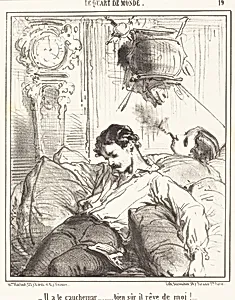
Il a le cauchemar...
1801 to 1825
Medium
lithograph on wove paper
Dimensions
overall: 34.4 x 25.2 cm (13 9/16 x 9 15/16 in.)
Classification
Department
CG-E
Museum
National Gallery of Art, Washington, D.C.
Credit
Gift of Frank Anderson Trapp
Accession Number
2002.57.3
Rights
Public Domain
Art Historical Context
**Il a le cauchemar (He Has the Nightmare...)** *Édouard de Beaumont,1801–1825* Lithograph on wove paper 34.4 × 25.2 cm National Gallery of Art, of Frank Anderson TrappCreated by French artist Édouard de Beaumont during early 19th century *Il a le cauche...* captures a moment of nocturnal torment through the innovative medium of lithography. This printmaking technique, pioneered just a few years earlier around 1796, allowed artists like de Beaumont to draw directly on stone with greasy crayon, producing rich tonal variations and fine details on smooth wove paper. The modest dimensions made such works accessible, ideal for dissemination in an era of political upheaval following the French Revolution and amid Napoleonic ambitions. The evocative title—"He Has the Nightmare..."—hints at satire or caricature, genres de Beaumont favored to comment on contemporary life. Produced between 1801 and 1825, it reflects lithography's rise as a democratic art form, enabling quick, affordable reproductions of humorous or critical scenes for a broad audience. Housed in the National Gallery of Art's print collection (Department CG-E), this gifted piece exemplifies how early lithographs bridged fine art and popular culture, blending technical innovation with witty social observation. Visitors will appreciate its crisp lines and shadowy drama, a testament to lithography's transformative impact on visual storytelling in post-Revolutionary France.