
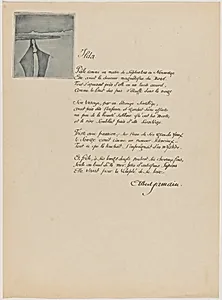
Ilda (Hilda)
Medium
saccharograph (sugar-lift aquatint?) in blue on heavy japan paper
Dimensions
plate: 8.5 x 8 cm (3 3/8 x 3 1/8 in.) sheet: 38 x 27.9 cm (14 15/16 x 11 in.)
Classification
Department
CG-E
Museum
National Gallery of Art, Washington, D.C.
Credit
Virginia and Ira Jackson Collection, gift in memory of Virginia H. Jackson
Accession Number
1996.151.21
Rights
Public Domain
Art Historical Context
**Ilda (Hilda)**, created in 1894 by French printmaker Maurice Dumont in collaboration with Symbolist poet Albert Samain, exemplifies the innovative printmaking of fin-de-siècle France. This intimate work, classified as a print in the National Gallery of Art's CG-E department, measures a modest plate size of just 8.5 x 8 cm, centered on a generous sheet of heavy Japan paper—prized for its absorbency and texture that enhances delicate impressions. Produced from the Virginia and Ira Jackson Collection, it honors the memory of Virginia H. Jackson through a thoughtful gift. The medium, a saccharograph (likely a sugar-lift aquatint) rendered in soft blue tones, showcases a rare technique where a sugar solution is brushed onto the plate to resist acid during etching, yielding fluid, painterly effects akin to watercolor. Popular among experimental artists of the 1890s, this method bridged traditional intaglio printing with emerging Symbolist aesthetics, emphasizing mood and subtlety over sharp detail. Dumont's mastery highlights the era's fascination with hybrid processes, blending poetry and visuals in a collaborative spirit. Housed in one of America's premier collections, **Ilda (Hilda)** invites visitors to appreciate how late 19th-century innovators like Dumont pushed print boundaries, capturing ephemeral beauty on enduring paper. A gem for print enthusiasts, it whispers of Symbolism's poetic allure. (198 words)