
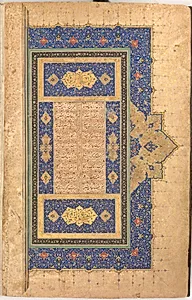
Illuminated Frontispiece of a Bustan of Sa`di
dated A.H. 920/ 1514 CE
Medium
Folio: Ink, opaque watercolor, and gold on paper Binding: Leather
Dimensions
Manuscript: H. 11 in. (28 cm) W. 7 5/16 in. (18.6 cm) D. 1 1/4 in. (3.2 cm)
Classification
Codices
Department
Islamic Art
Museum
Metropolitan Museum of Art, New York, NY
Credit
Purchase, Louis V. Bell Fund and The Vincent Astor Foundation Gift, 1974
Accession Number
1974.294.1
Rights
Public Domain
Art Historical Context
This stunning *Illuminated Frontisp of a Bustan of Sa`di*, created by the Persian artist Sultan Muhammad Nur in 4 CE (A.H. 920), opens a luxurious manuscript of the 13th-century poet Sa`di's *Bustan* ("Orchard"), a collection of moral tales and teachings in verse. Housed in the Metropolitan Museum of Art's Islamic Art Department, this folio exemplifies the early Safavid era's artistic brilliance under Shah Ismail I, when Tabriz emerged as a hub for illuminated manuscripts blending poetry, spirituality, and royal patronage. Crafted with ink, opaque watercolor, and lavish gold on paper, bound in leather, the frontispiece measures about 11 by 7 inches. Its intricate designs—featuring floral motifs, arabesques, and possibly symbolic figures—highlight Persian miniature techniques: fine-line drawing for precision, vibrant gouache-like pigments for jewel-toned depth, and gold leaf for a luminous, heavenly glow. These elements not only beautified sacred texts but also elevated everyday reading into a meditative experience, reflecting Islam's rich tradition of calligraphy and illumination. As a codex purchased in 1974 through the Louis V. Bell Fund and The Vincent Astor Foundation Gift, it invites visitors to appreciate how Safavid artists like Sultan Muhammad Nur fused literary heritage with visual splendor, making timeless wisdom accessible and enchanting.