
Imperial Jade-Handled Knife
Unknown Artist
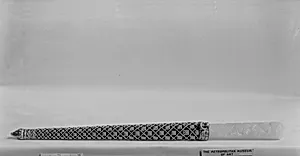
Medium
Nephrite, white with very faint bluish tint
Dimensions
H. 4 7/8 in. (12.4 cm); W. 7/8 in. (2.2 cm); D. 5/8 in. (1.6 cm)
Classification
Jade
Culture & Period
China · Qing dynasty (1644–1911), Qianlong period (1736–95)
Department
Asian Art
Museum
Metropolitan Museum of Art, New York, NY
Credit
Gift of Heber R. Bishop, 1902
Accession Number
02.18.736a, b
Rights
Public Domain
Art Historical Context
Behold the **Imperial Jade-Handled Knife a exquisite testament to Qing dynasty craftsmanship from the Qianlong period (6–95). Carved from nephrite jade—renowned in China for its toughness and luminous quality—this handle gleams with a pure white tone accented by a very faint tint, a rare and prized variation evoking imperial purity. Measuring just 4 7/8 inches high, its petite scale suggests it adorned a ceremonial dagger rather than a utilitarian blade, fitting for the opulent court of Emperor Qianlong, a fervent collector and patron of the arts. In Chinese culture, jade symbolized virtue, immortality, and heaven's favor, reserved for emperors and high elites. The Qianlong era marked the zenith of jade carving, with artisans employing masterful techniques like incising, drilling, and polishing to achieve flawless translucency and subtle motifs—though specifics here remain enigmatic due to the unknown artist's hand. Such imperial objects underscored the dynasty's cosmopolitan empire, blending Confucian ideals with technical virtuosity. Today, this treasure graces the Metropolitan Museum of Art's Asian Art collection, a gift from Heber R. Bishop in 1902. It invites us to ponder the blade's untold stories—of ritual, power, or protection—in an age when jade rivaled gold in splendor.