
Impressions of intaglios after the statuary of Canova and Thorvaldsen
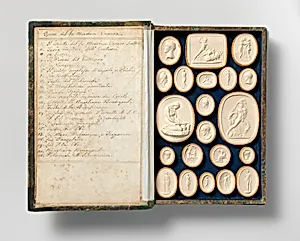
Medium
Gesso, paper, leather
Dimensions
Overall: 10 × 6 3/4 × 2 3/16 in. (25.4 × 17.1 × 5.6 cm)
Classification
Gesso
Culture
Italian, Rome
Department
European Sculpture and Decorative Arts
Museum
Metropolitan Museum of Art, New York, NY
Credit
Gift of Joseph D. Ryle, 1992
Accession Number
1992.405.1–.35
Rights
Public Domain
Tags
Art Historical Context
In the heart of 19th-century Rome, Carnesecchi crafted this exquisite set of gesso intaglio impressions, directly from the neoclassical masterpieces of Antonio Can and Bertel Thorvalen. Dated around 1822–44, the work captures profiles and figures—including striking male nudes and elegant women—in delicate relief. Housed in a compact leather-bound volume (10 × 6¾ × 2¼ inches) with gesso and paper, it exemplifies the era's innovative reproductive techniques, allowing collectors to own portable echoes of grand statuary. Canova and Thorvaldsen, titans of neoclassicism, revived ancient Greek and Roman ideals of harmony and heroism in their marble sculptures. Carnesecchi's impressions served as affordable souvenirs for Grand Tour travelers, preserving the sculptors' refined contours through the low-relief intaglio process—essentially a reverse casting that pressed gesso into molds for sharp, tactile detail. This Italian Roman artifact, now in the Metropolitan Museum of Art's European Sculpture and Decorative Arts collection (gift of Joseph D. Ryle, 1992), highlights how such objects democratized high art, bridging elite patronage and public admiration during a golden age of classicism.
About the Artist
Francesco Carnesecchi|Antonio Canova|Bertel Thorvaldsen (Italian|Italian|Danish) · 1800 |1757 |1770 –1900 |1822 |1844
Italian|Italian, Possagno 1757–1822 Venice|Danish, Copenhagen 1770–1844 Copenhagen