
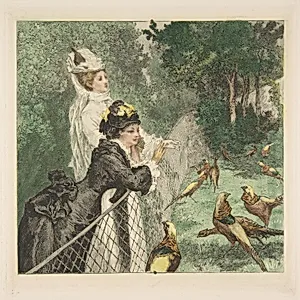
In the Zoological Garden
ca. 1873
Medium
Etching, drypoint, and aquatint printed in color; seventh state of seven
Dimensions
Sheet: 12 11/16 × 10 3/16 in. (32.3 × 25.8 cm) Plate: 8 9/16 × 8 1/2 in. (21.8 × 21.6 cm)
Classification
Prints
Department
Drawings and Prints
Museum
Metropolitan Museum of Art, New York, NY
Credit
Rogers Fund, 1922
Accession Number
22.15.3
Rights
Public Domain
Tags
Art Historical Context
Félix Bracquemond's *In the Zoological Garden* (ca. 1873) captures a leisurely moment in a Parisian zoo, likely inspired by the popular Jardin d'Acclimatation or Jardin des Plantes The etching features women amid lush gardens and exotic birds, evoking the 19th-century fascination with, leisure, and global exploration. Bracquemond, a French printmaker and etcher, was a pioneer in reviving etching as a fine art, blending it with influences from Japanese woodcuts that emphasized flat color and decorative patterns. This seventh and final state showcases Bracquemond's mastery of complex techniques: etching for precise lines, drypoint for soft, velvety burrs, and aquatint for subtle tonal gradations. Printed in color—a rarity in Western printmaking at the time—it achieves vibrant effects akin to painting, highlighting his role in advancing color etching during the Impressionist era. The intimate plate size (8 9/16 × 8 1/2 in.) invites close viewing, revealing the medium's textural richness. Acquired by The Metropolitan Museum of Art via the Rogers Fund in 1922, this print reflects the Gilded Age's appreciation for technical innovation and urban escapism, offering visitors a window into Bracquemond's elegant world of avian splendor and feminine poise.
About the Artist
Félix Bracquemond · 1833–1914
French, Paris 1833–1914 Sèvres